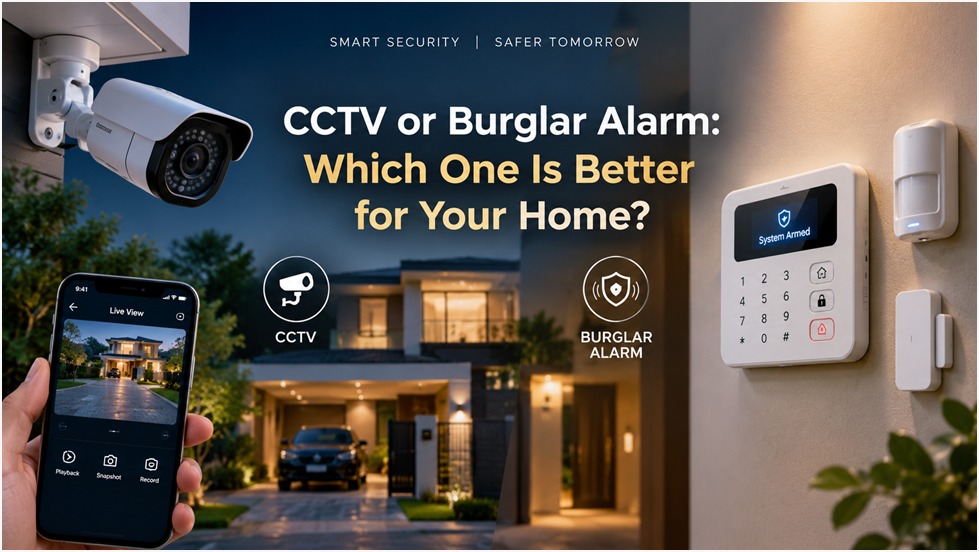
CCTV or Burglar Alarm: Which One Is Better for Your Home?
It's a familiar worry for many homeowners: you step out for a family function or a short vacation, and somewhere in the back of your mind sits a nagging question — is your home actually protected while you're away, or just being watched?
CCTV and burglar alarms often get lumped together as "security systems," but they do very different jobs. CCTV lets you see what is happening in and around your home. A burglar alarm is built to detect an intrusion and immediately raise an alert.
CCTV systems and burglar alarms fulfill distinct functions, thus the optimal selection is contingent upon the specific protection requirements of your home. For active intrusion detection, a burglar alarm systems for homes setup provides an important additional layer of security.
CCTV vs. Burglar Alarm – What Distinguishes Them?
The simplest method to grasp the distinction is to consider the concepts of "monitoring" versus "sensing."
| Feature | CCTV | Burglar Alarm |
|---|---|---|
| Main purpose | Visual monitoring and recording | Intrusion detection and alerting |
| How it detects a threat | Requires someone to view footage (live or recorded) | Sensors trigger automatically on entry, motion, or glass break |
| What happens after detection | Footage is stored for review | Siren sounds and/or mobile alert is sent instantly |
| Remote monitoring | Yes, via mobile app | Yes, via mobile app for alerts |
| Evidence and recording | Strong video proof of events | Limited, mainly logs of triggered events |
| Intrusion alerts | Not automatic unless paired with AI motion alerts | Core function of the system |
| Best use case | Reviewing incidents, monitoring entrances | Immediate response to break-ins |
Neither system is "better" in every situation — they're built to solve different problems.
How Does CCTV Protect Your Home?
CCTV cameras for home security give homeowners visibility they wouldn't otherwise have. A well-placed camera setup can:
- Monitor the main gate, entrance, and outdoor areas
- Let you check in on your property from your phone, wherever you are
- Record footage that helps identify people or vehicles after an incident
- Act as a visible deterrent for casual intruders
- Keep an eye on deliveries, domestic help, or children arriving home
That said, CCTV has a real limitation worth understanding. CCTV mainly provides visibility and evidence; it does not necessarily provide an immediate physical or audible response to an intrusion. If no one is watching the live feed at the moment someone tries to break in, the camera simply records the event — it doesn't stop it or alert anyone in real time.
How Does a Burglar Alarm Protect Your Home?
This is the point at which a burglar alarm system addresses the need. Modern burglar alarms are built around a network of sensors and triggers, including:
- Door and window sensors that detect unauthorized opening
- Motion sensors that pick up movement inside a room after hours
- Glass-break detectors for windows and sliding doors, where appropriate
- Loud sirens that alert occupants and neighbours immediately
- Mobile notifications so you're informed even when you're away
- Tamper detection that flags attempts to disable the system
- Wireless connectivity for easier installation and flexible sensor placement
Because these components work together, a burglar alarm for home use can detect a possible intrusion and alert occupants within seconds, making it an active security layer rather than only a recording system. Many smart burglar alarm systems now sync with mobile apps, so you get a push notification the moment a sensor is triggered — not after you've had time to review footage.
CCTV or Burglar Alarm – Which Option Is Superior for Your Residence?
Choose CCTV if your main priority is visibility — watching entrances, keeping an eye on your property remotely, and having recorded evidence if something happens.
Choose a burglar alarm if your priority is immediate intrusion detection — you want to know the instant someone tries to enter, not after the fact.
For stronger protection, combining CCTV and burglar alarm systems can give you both visibility and active intrusion detection working together. No system, however, can guarantee that a burglary will never happen — the goal is to reduce risk and improve your response time, not eliminate risk entirely. You can get a free security consultation to work out the right combination for your property.
Want to know which security setup suits your home? Every property has different entry points, layouts, and security requirements. A professional assessment can help you identify the right combination of CCTV cameras, door sensors, motion detectors, and alarm devices for your specific home.
Speak with a security professional today and get a suitable home security recommendation.
Why Combining CCTV and Burglar Alarms Can Be Better
Think of it this way: CCTV = See + Record. Burglar Alarm = Detect + Alert.
Together, they follow a simple sequence: Detect → Alert → Verify → Respond.
Here's a realistic scenario: a door sensor detects an unauthorized opening late at night. The burglar alarm triggers instantly, sounding a siren and sending a mobile alert. You check the linked CCTV footage from your phone to verify what's actually happening before deciding how to respond — whether that's contacting a neighbour, your security provider, or the police. Each system compensates for what the other can't do alone.
What Factors Should You Take into Account Prior to Installing a Home Security System?
Before selecting equipment, it is beneficial to survey your property while keeping these considerations in mind:
- Number of entry points — main doors, windows, balcony access, garage
- Overall property size and layout
- Whether you have pets that could trigger motion sensors
- Reliable internet connectivity for mobile alerts
- Power backup in case of outages
- Indoor versus outdoor camera placement
- Sensor placement to avoid false alarms
- Room for future expansion as your needs grow
Independent houses typically need more sensors and outdoor cameras due to multiple entry points, while apartments often need fewer devices focused on the main door and balcony.
Why Professional Installation Matters
Acquiring quality equipment constitutes merely half of the task. Performance depends heavily on:
- Correct sensor placement so nothing is missed
- Camera positioning that avoids blind spots
- Proper configuration and testing after installation
- Reliable network setup for consistent mobile alerts
- Periodic maintenance to keep everything working
Poorly placed sensors or badly angled cameras can leave real gaps in coverage, even with expensive hardware. For homeowners looking for an integrated approach, Esquire Automation offers smart home automation solutions that can help combine intrusion protection with modern home automation, supported by proper installation and configuration.
According to the NCRB's Crime in India 2024 report, traditional theft cases declined nationally, while burglary rates stayed relatively stagnant — a sign that break-ins remain a persistent, ongoing concern for households even as some other property crimes decrease. Alongside this, industry research from IMARC Group projects India's smart home security market to grow at a compound annual rate of over 26% between 2026 and 2034, reflecting rising homeowner interest in devices like smart burglar alarms and connected CCTV systems.
Conclusion
CCTV and burglar alarms solve different problems — one gives you visibility and evidence, the other gives you instant detection and alerts. For most homes, the strongest setup combines both, so you're covered from the moment someone tries to get in to the moment you need to review what happened.
Ready to secure your property the right way? Explore our home security solutions and let Esquire Automations recommend a setup built around your home's entry points and layout.
